

You have a code ready to buy or redeem. The price looks fine, delivery is instant, and nothing seems unusual. The real question is narrower: will this code work on your account, in the store your account uses, without forcing a workaround?
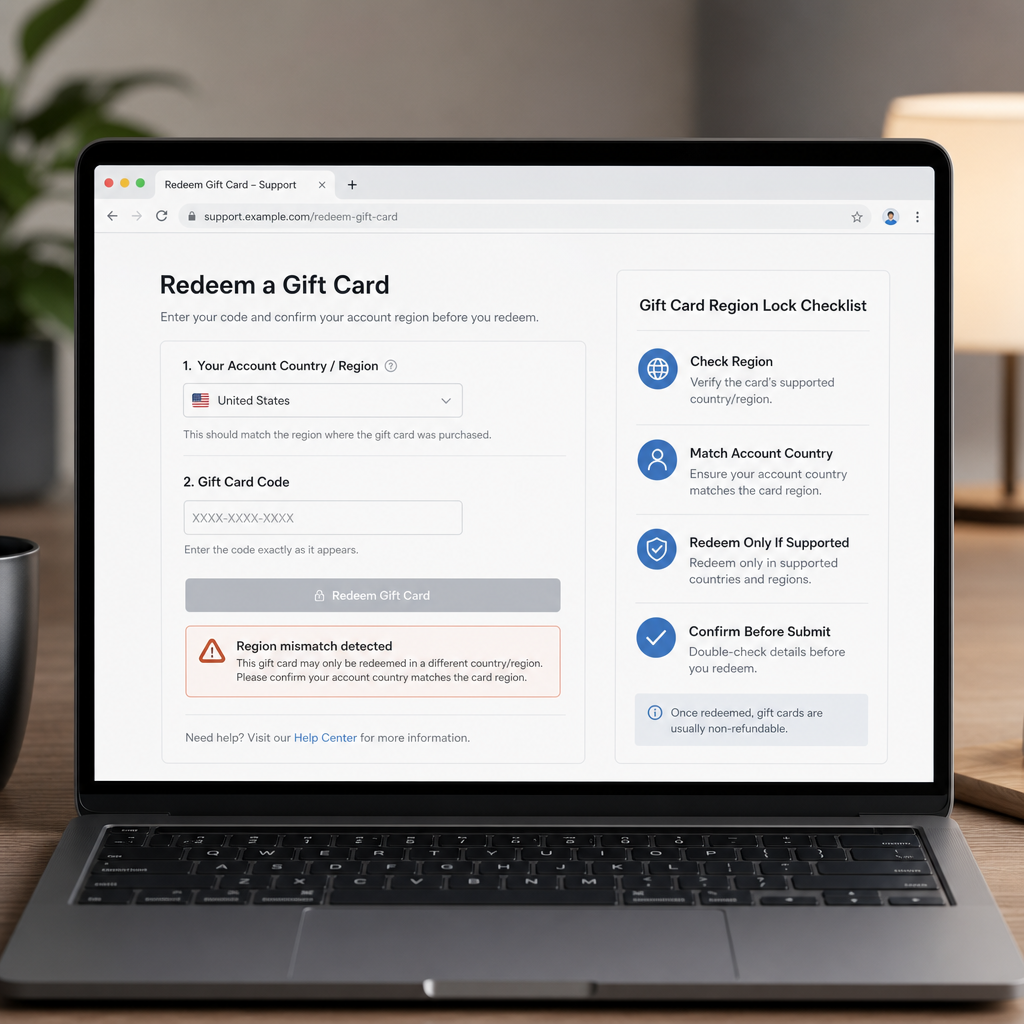
That is where gift card buyers get burned. A code can be genuine, unused, and still useless to you because of region lock, country rules, currency mismatch, or an account country mismatch. Once the code is shown or activated, many sellers treat the sale as final, even if the mistake was simply buying the wrong regional version.
Before you redeem, check what you are actually buying, what value you will get after restrictions, and whether the card matches your platform account. This is the checklist worth running before any gift card code is activated.
What You Actually Get
A gift card redeem code is not universal money. It is usually platform-specific balance, wallet credit, subscription credit, game currency, or store credit tied to a particular country or region. The amount printed on the card matters, but the redemption rules behind it matter more.
A USD card, for example, may only work on a United States account. A euro card may be limited to certain European stores rather than every country that uses euros. A game-specific card might work only in the publisher’s own store, not on console, mobile, or a third-party launcher. Some cards add wallet balance. Others unlock a fixed item, subscription period, or premium currency bundle.
Before buying or redeeming, check these five items:
- Platform: Is it for PlayStation, Xbox, Nintendo, Steam, Google Play, Apple, Roblox, Fortnite, Riot, or another specific service?
- Region compatibility: Does the card match your account country, not just where you happen to be?
- Currency: Is the card in the same currency used by your account store?
- Content type: Is it wallet credit, in-game currency, a subscription, DLC, or a fixed product code?
- Activation status: Has the seller revealed, scanned, or activated the code properly?
The account country is usually the deal-breaker. If your account is registered in Canada and you are traveling in Japan, a Japan-region gift card may not redeem on that Canadian account. A VPN is not a dependable fix either. Many platforms check account country, billing region, store region, or account history, not only your current IP address.
Be careful with the word “global.” Some global cards really are multi-region. Others are sold worldwide but redeem only in one country. If the product page does not list supported countries clearly, treat that as a warning sign.
Price-to-Value Check
A discount only matters if the code redeems cleanly and gives you credit you can actually use. A $50 gift card for $44 looks good until it requires a separate regional account, blocks the purchase you wanted, or cuts you off from local payment options.
Start with the card’s face value and compare it with your account store’s pricing. If a game costs $69.99 in your local store, a foreign-region card may not help if it cannot be applied there. Even when redemption in another region looks technically possible, you may run into store language differences, tax rules, DLC compatibility issues, or purchase limits.
Then check the real checkout cost. Some marketplaces lead with a low price and add service fees, payment fees, exchange-rate margins, or delivery charges later. If the discount is only 2% and the card has strict country restrictions, the risk probably is not worth it. Region-locked codes should usually be cheaper than fully compatible cards because the buyer is taking on more responsibility.
For gaming top-ups, the best value usually comes from cards that match your existing account country exactly. You avoid failed redemption, unusable wallet balance, and split libraries. A smaller discount on the correct region often beats a larger discount on a code that depends on tricks.
Timing matters too. Platform sales, seasonal bundles, and in-game events can change a gift card’s value quickly. If you are buying credit for a specific promotion, confirm that the card can be redeemed immediately and that the resulting balance can be used on that offer. Some subscription and promotional cards have exclusions or delayed activation windows.
When This Deal Makes Sense
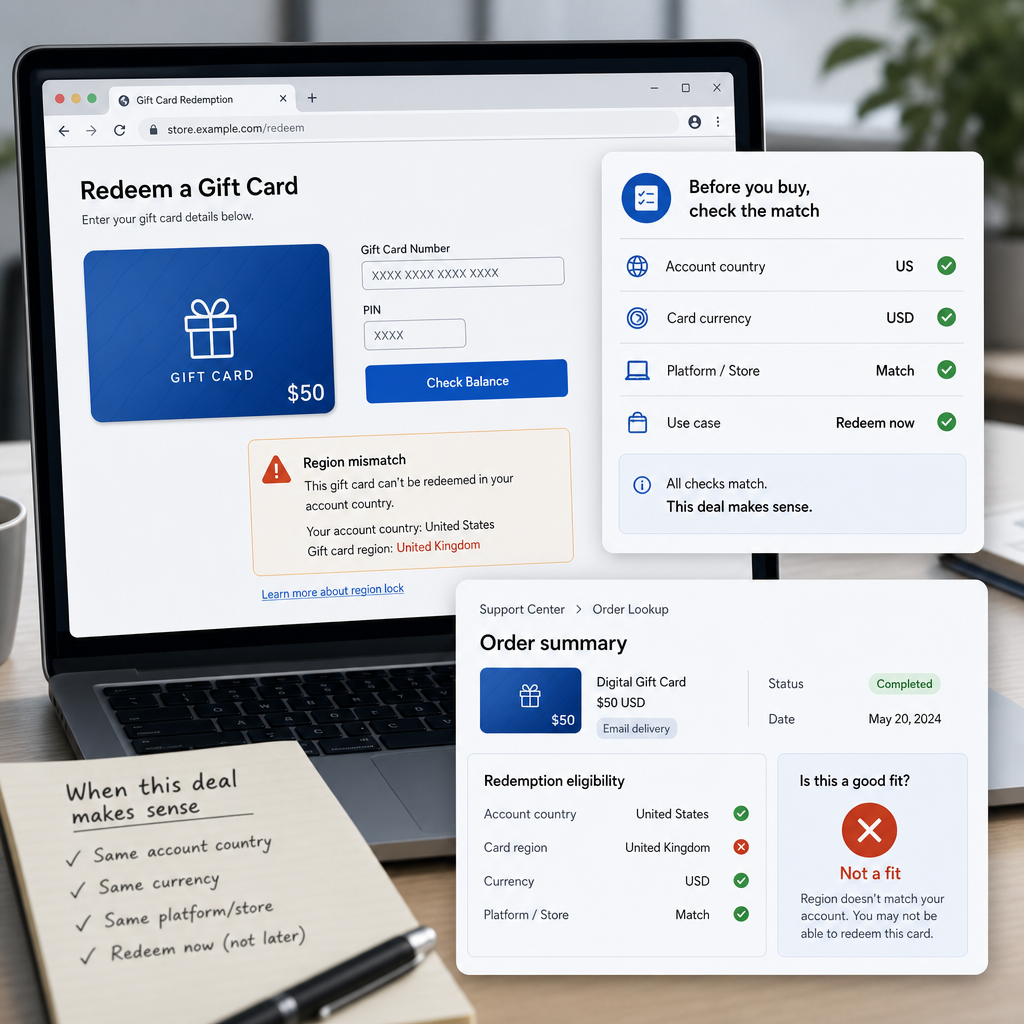
A gift card deal makes sense when the region, account, currency, and intended purchase all line up. If you can say yes to the points below, you are in a safer position before activation.
- Your account country matches the card country. This is the cleanest setup and the least likely to fail.
- The store currency matches the card currency. A USD account with a USD card is clearer than mixing currencies and hoping for conversion.
- The product page states the region clearly. “US only,” “UK account required,” or “EU region” is better than vague wording.
- You know what you will buy with the balance. The card is more useful when it serves a specific game, subscription, DLC, or top-up plan.
- The seller explains refund rules before code delivery. If the code is non-refundable after reveal, you need to know before paying.
- You are not relying on a VPN as the main solution. If the deal only works through technical tricks, it is not a clean deal.
This kind of offer is most straightforward for players who use one primary account and keep buying from the same regional store. If you have a long-term US PlayStation account, buying US PlayStation wallet cards from a reliable seller can be simple. The same logic applies across platforms: match the card to the account region, then redeem normally.
It can also work for gifting, but only if you know the recipient’s account country. Do not assume their current residence matches their account region. Plenty of players created accounts years ago in another country and never changed them. Send the wrong region and they may receive a valid code they cannot use.
For parents buying cards for children, check the account settings on the actual device or platform before purchasing. The country shown in the account profile or store settings is more useful than guessing from where the console is sitting.
Risk Warnings
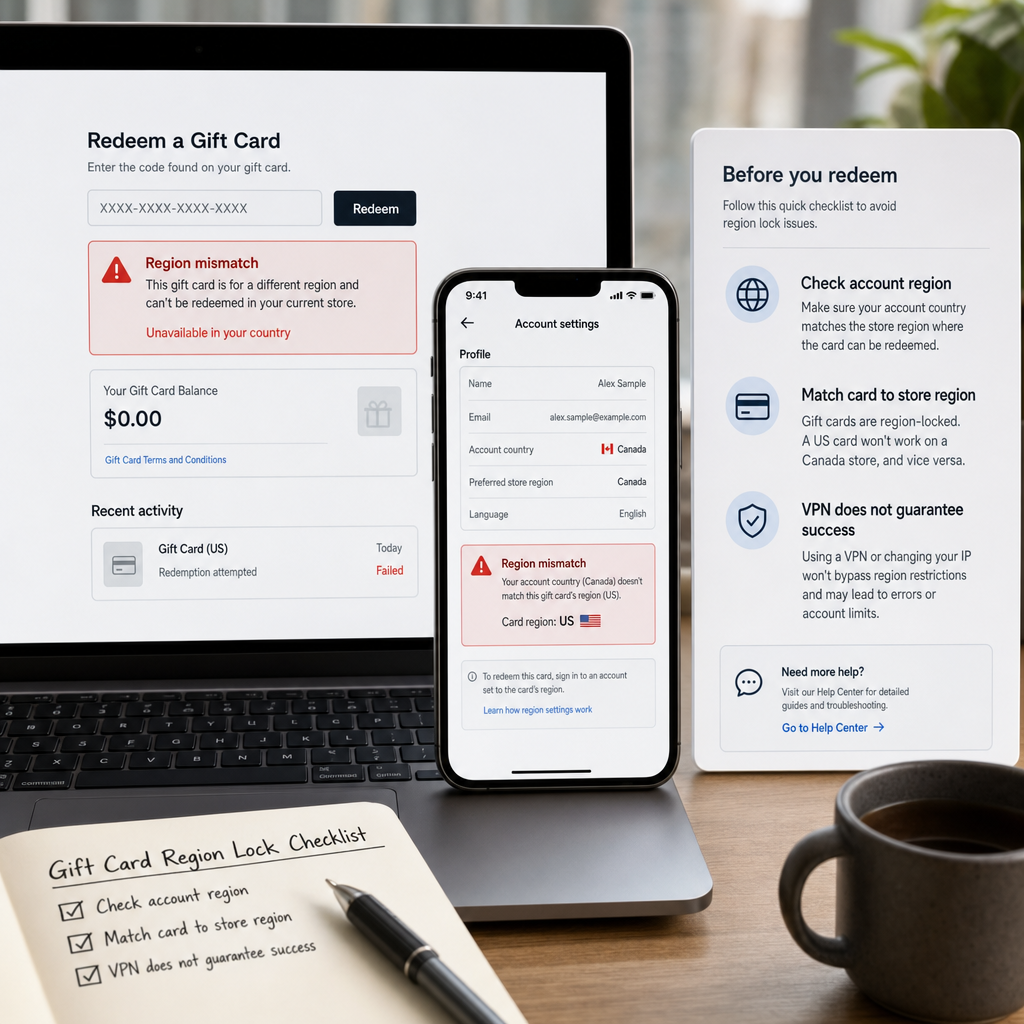
The main risk is a valid but incompatible code. Support may confirm that the code is genuine and unused while still refusing to convert it to another region. Sellers often cannot take it back once exposed because a revealed redeem code can be copied in seconds.
Watch for these warning signs before purchase:
- No country listed: A gift card page that hides the region is not buyer-friendly.
- Confusing wording: Phrases like “works worldwide” next to “US account only” need clarification before checkout.
- Too-good pricing: Deep discounts on popular gift cards may involve higher fraud, chargeback, or sourcing risk.
- Code screenshot delivery: A typed code from a reputable system is usually cleaner than an unclear image, unless the seller is known and trusted.
- Pressure tactics: “Buy now, no questions, instant code” is not a substitute for region compatibility information.
Account country mismatch deserves extra attention. Some platforms allow country changes only under certain conditions. Others require local payment methods, local billing addresses, or support review. A few make country changes difficult or limit how often you can do it. If you buy a wrong-region card assuming you can just change the account country, you may be stuck.
DLC and game-region compatibility can also cause trouble. On consoles in particular, wallet credit, base games, DLC, and account regions may not line up cleanly. A game bought from one regional store may not accept DLC bought from another. If your plan is to use a regional gift card for add-ons, check the game’s region compatibility first.
Do not ignore tax and balance rules. Some stores apply tax at checkout, so the card’s face value may not cover the full purchase. Others leave small leftover balances that are awkward to spend. That does not make the card bad, but it changes the real value.
FAQ
Can I redeem a gift card in another region?
Sometimes, but assume no unless the platform clearly supports it. Most major digital stores tie gift card redemption to the account country or store region. Your physical location usually matters less than the country assigned to your account.
What does account country mismatch mean?
It means the gift card country does not match the country set on your platform account. A UK gift card used on a US account is a mismatch. The code may be valid, but the platform can still reject it because of country restrictions.
Will a VPN help bypass region lock?
A VPN is not a reliable solution. Platforms often check account country, payment region, previous store activity, and redemption rules. Using a VPN may also violate platform terms or trigger security checks. Buy the correct region instead of building the purchase around a workaround.
How do I check gift card region compatibility before activation?
Check the product title, terms, country list, currency, platform account settings, and seller notes. If anything is unclear, ask the seller before the code is revealed. Once the redeem code is delivered, refunds are usually much harder.
Are global gift cards safe to buy?
They can be, but “global” still needs proof. Look for a supported-country list or platform confirmation. If the card is described as global but hides exclusions, it may not work for your account.
What should I do if I bought the wrong region?
Do not keep trying random redemption methods. Contact the seller immediately and do not share the code publicly. If the code has not been viewed or redeemed, some sellers may help. If it has already been revealed, your options are often limited.
Bottom Line
A gift card deal is only good if it fits your account. Region lock and country restrictions are not harmless fine print. They decide whether the redeem code has practical value at all. Before activation, check the card country, your account country, the platform, the currency, and the exact thing you plan to buy.
If everything matches, a discounted card can be a simple way to top up a wallet or pay for games, DLC, subscriptions, and in-game currency. If the region details are vague, stop and verify them before the code is shown. A few minutes of checking is better than owning a perfectly valid code your account will never accept.