

You find a discounted game key, the price looks good, and then the checkout page makes you slow down. Fair. Before you pay, you need to know whether the listing is for the full game, DLC, an upgrade, or something stranger. You also need to know whether the code will activate in your region and what happens if the order goes wrong.
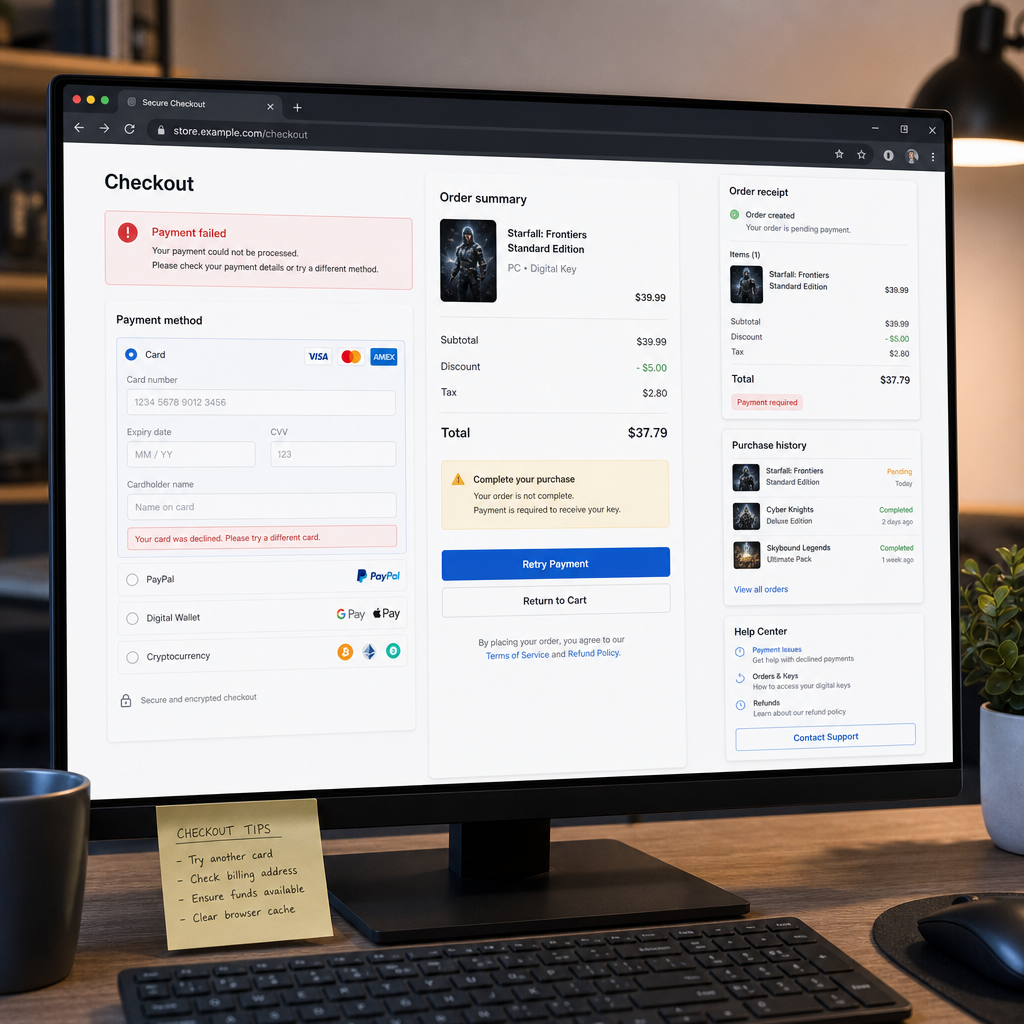
The safest move is to treat the checkout page as part of the product, not just the payment step. Look at the platform, edition, activation region, delivery time, fees, currency, and refund terms before entering card or wallet details. A cheap key is only a deal if it works on the right account and the final billed amount still makes sense.
What You Actually Get
A Game CDKey is a digital activation code used to redeem a game, expansion, subscription, in-game currency, or downloadable content on a specific platform. That platform might be Steam, Epic Games, Ubisoft Connect, EA app, Battle.net, Xbox, PlayStation, Nintendo, or a publisher launcher. The code is not the game file. It is the license that tells the platform your account can access the product.
Read the product title and edition before checkout. Many bad purchases start with a wrong comparison. A Standard Edition key is not the same as a Deluxe Edition. A DLC key will not include the base game. An upgrade pack will not work unless you already own the required version. If the listing says “account,” “gift,” or “offline activation” instead of “activation code,” treat it as a different product and read the terms with more suspicion.
Check the activation region too. A global key usually has broad support, but “global” does not always mean every country on every platform. Region-locked keys may only activate in Europe, North America, Latin America, Asia, or another named area. Some codes activate widely but still carry language limits or local content differences. If your billing address, platform account region, and physical location do not match, the region rules matter even more.
Delivery is usually instant or close to it after payment. The key may appear on the order page, inside your account dashboard, or by email. Some stores hold first-time orders for manual review, especially for expensive keys or unusual payment activity. That is not automatically a warning sign, but it matters if you are buying right before a weekend session or a limited-time event.
Price-to-Value Check
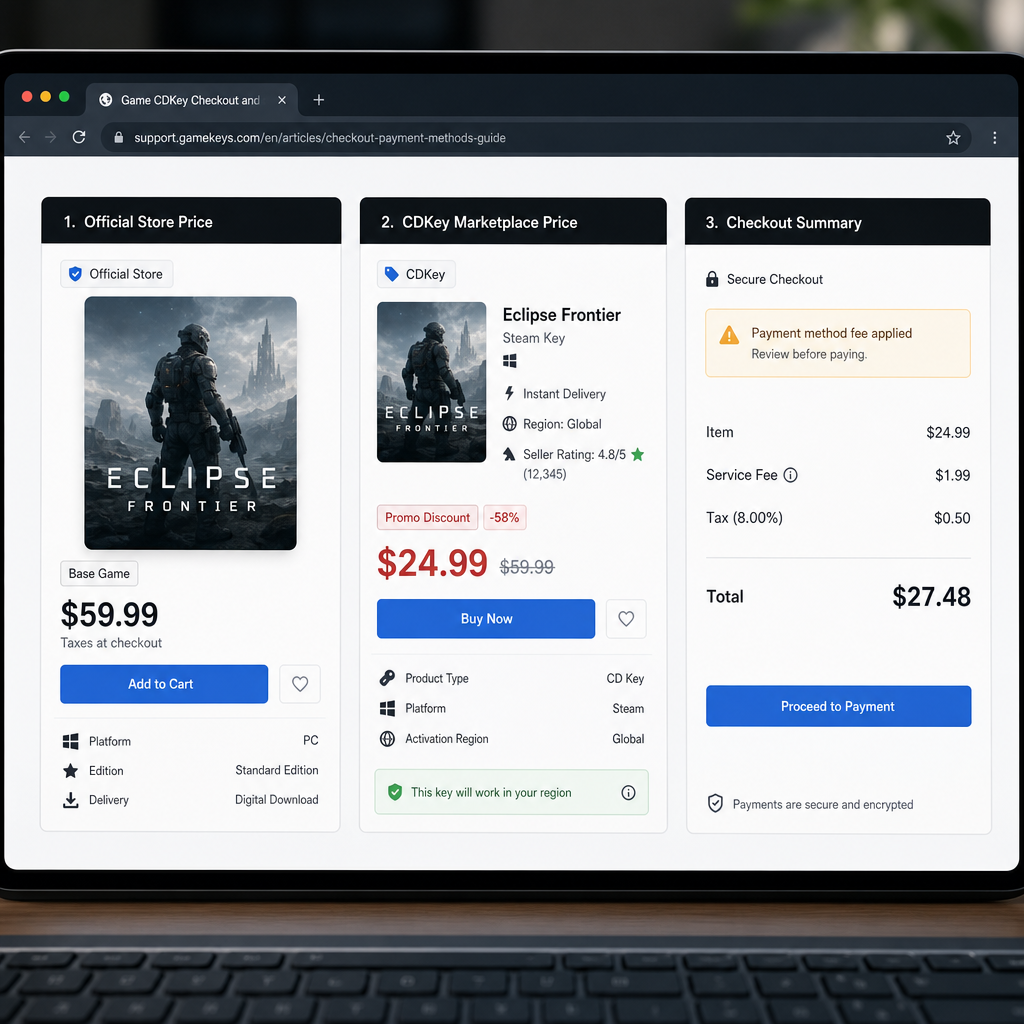
The real question is not simply whether the key is cheap. It is whether the savings justify the trade-offs. Compare the CDKey price with the official platform store, recent seasonal sale prices, and any subscription access you already have. A key that is only 10% cheaper than a regular official sale may not be worth weaker refund options. A key that is 40% cheaper for a well-reviewed complete edition is a different story.
Watch the total at checkout. Some sellers advertise a low product price, then add service fees, payment handling fees, tax, or currency conversion later. The final amount on the billing page is the only number that counts. If your card is issued in another currency, your bank may also add a foreign transaction fee, even if the store shows a converted estimate.
Your payment method affects the value of the deal. Credit cards may give you chargeback rights, fraud monitoring, and clearer dispute records. Debit cards are easy to use but may pull money directly from your bank balance while a dispute is reviewed. Wallets can add a privacy layer and speed up checkout, though buyer protection depends on the wallet provider and merchant category. Prepaid cards work on some stores and fail verification on others.
If the store offers regional payment options, compare them before paying. Local bank transfer, instant payment networks, mobile wallets, or region-specific gateways can reduce conversion costs. The trade-off is recovery. Some local methods are difficult to reverse if the key is invalid or the order is disputed. For most buyers, the best checkout option is the one that balances fees, confirmation speed, and dispute protection.
Timing also matters. A CDKey deal makes less sense if an official store sale is likely to start within a few days, especially around major seasonal events. If the game just left a sale and you want to play now, a reliable key at a moderate discount can be practical.
When This Deal Makes Sense
A Game CDKey purchase makes sense when the listing is specific, the platform matches your account, the region is clearly supported, and the final checkout price still beats realistic alternatives. It is often a reasonable choice for older games, complete editions, multiplayer titles your friends already play, or single-player releases where deluxe preorder bonuses are not the point.
Use a quick checklist before you pay. First, confirm the platform. A Steam key will not redeem on PlayStation, and an Xbox code may be limited by console or Microsoft Store terms. Second, confirm the edition. Look for base game, DLC, season pass, deluxe content, soundtrack, or bonus pack wording. Third, confirm activation region and language. Fourth, check delivery time and whether the seller requires identity review. Fifth, read the refund policy for revealed keys.
The payment step deserves the same attention as the listing. On the checkout page, make sure the order summary shows the correct item, quantity, price, tax, and currency. If you see optional protection fees, discount code boxes, loyalty points, or wallet balance options, understand what they change before placing the order. Some add-ons may be useful for higher-value purchases. Others just raise the total.
For card checkout, use a card with strong fraud alerts and avoid saving it unless you plan to use the store again. For wallet checkout, confirm that the wallet email and billing details are current so the order does not get flagged. For regional payment options, check whether payment confirmation is instant or delayed. A bank transfer that settles tomorrow is not useful if you need the key tonight.
This type of deal also makes sense if you are comfortable handling activation yourself. You will usually need to copy the code exactly, open the correct platform client or redemption page, sign in to the right account, and complete activation. Once redeemed, the code is typically locked to that account permanently.
Risk Warnings
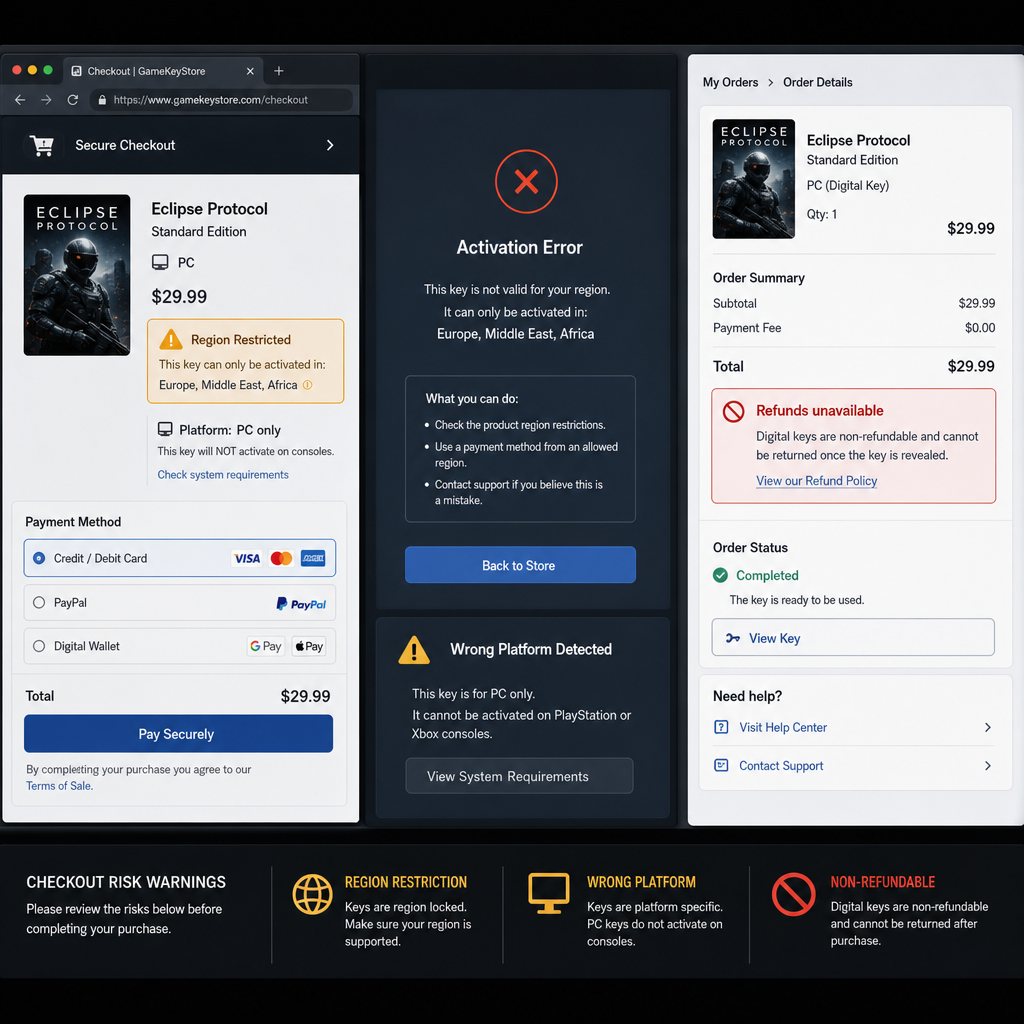
The biggest risk with a Game CDKey is not the payment method by itself. It is buying the wrong key, for the wrong region, on the wrong platform, under refund terms that stop protecting you once the code is displayed. Most stores will not refund a valid revealed key, even if you later realize you wanted a different edition.
Be careful with prices that sit far below every other seller without an obvious reason. Big discounts do happen, especially for older games or surplus regional stock, but extreme underpricing should make you slow down. Look for seller history, order guarantees, support response expectations, and whether the marketplace separates the storefront from individual sellers.
Payment risk varies by method. A credit card generally gives you the strongest fallback if a merchant fails to deliver, though chargebacks should come after a real attempt to contact support. Wallets may make checkout cleaner, but protection rules can be narrower for digital goods. Crypto, bank transfer, and some local instant payment methods may be fast, but recovery can be limited if something goes wrong.
Billing mismatches can also create friction. If your IP location, billing country, card country, and platform account region all differ, the order may be delayed or declined. That does not automatically mean the store is unsafe. Fraud systems are strict with digital codes because delivery is hard to undo. Still, if a shop asks for excessive personal documents for a small purchase, ask whether the discount is worth the privacy trade-off.
Do not use VPN tricks to activate a region-locked key unless you fully understand the platform rules. Some platforms may reject activation, restrict access, or treat region bypassing as a terms violation. Saving a few dollars is not worth risking a main gaming account with years of purchases attached to it.
FAQ
What payment methods are usually supported for Game CDKey checkout?
Common options include credit cards, debit cards, PayPal or similar wallets, store wallet balance, prepaid cards, and local regional payment methods. Availability depends on your country, the store, fraud checks, and the order value.
Is card or wallet checkout better for buying a game key activation code?
Card checkout is often better if you want strong billing records and possible dispute protection. Wallet checkout can be faster and may keep your card details away from the merchant. For a first purchase from a store you have not used before, many buyers choose a credit card or reputable wallet instead of direct bank transfer.
Why was my payment accepted but my CDKey not delivered instantly?
Digital key stores sometimes hold orders for manual review. This can happen with first-time buyers, high-demand games, mismatched billing data, VPN use, unusual card behavior, or regional payment methods that take longer to confirm. Check the order status before placing a second order.
Can I get a refund after the activation code is shown?
Usually not if the key is valid and has been revealed. Digital codes are hard to resell once displayed. You may have a stronger case if the code is invalid, was already used before delivery, or does not match the listing. Save the order details and contact support quickly.
Do regional payment options affect whether the key activates?
The payment method usually does not control activation. The key region and your platform account region matter more. Still, using a local payment method may confirm your billing country, which can affect fraud review or store eligibility.
What should I check on the billing page before paying?
Check the game title, edition, platform, region, quantity, final price, tax, fees, currency, delivery estimate, and refund terms. If any part of the order summary looks vague, pause before completing checkout.
Bottom Line
A Game CDKey can be a smart buy when the listing is clear, the discount survives checkout fees, and the payment method gives you a reasonable fallback. The best deal is not always the lowest sticker price. It is the one where the platform, edition, activation region, supported payment method, and final billing total all line up before you pay.
If you are choosing between payment methods, use the option that gives you a clean record, manageable fees, and a realistic dispute path. For cautious buyers, that usually means a credit card or trusted wallet rather than an irreversible method. If the savings are minor, the official store may be the cleaner choice. If the savings are meaningful and the key details check out, a CDKey can be a practical way to get the game without overpaying.